- OpenAILearning
- Posts
- OpenAI ships GPT-5.6
OpenAI ships GPT-5.6
200+ Proven Ways To Make Money Online + 12 Camera Moves Every AI Film-maker Should Know

Shailesh Shakya
July 06, 2026

In today’s Newsletter
OpenAI ships GPT-5.6
200+ Proven Ways To Make Money Online
Anthropic Fable 5 is Back
10 Cinematic Prompts Techniques For Video
Midjourney + GPT IMG 2.0 + Seedance 2.0
10 Practical Tips for Character Consistency
Google's answer to expensive video: a four-second image model and a talk-to-edit engine
Bullet Tracking Shot (+ prompt)
12 Camera Moves Every AI Film-maker Should Know
AI & Tech News
OpenAI ships GPT-5.6

On 26 June, OpenAI previewed GPT-5.6 in three tiers: Sol, its flagship, priced at 5 dollars input and 30 dollars output per million tokens; Terra, a balanced model at 2.50 dollars and 15 dollars that OpenAI says matches GPT-5.5 at lower cost; and Luna, its cheapest option at 1 dollar and 6 dollars. The launch was unusual because access went initially to a narrow set of approximately 20 organizations whose participation was cleared after OpenAI shared the models and release plans with the US government, a step the company said followed its engagement with Washington and one it explicitly does not want to become the default.
Sol posts gains in coding, biology, and cybersecurity, adds an "Ultra" mode that splits work across sub-agents, and is slated to run on Cerebras at up to 750 tokens per second in July. The episode matters because it confirms that the US now treats the most capable domestic models as products subject to pre-release review, the same posture that had already ensnared Anthropic. Source link: openai
200+ Proven Ways To Make Money Online
200+ Proven Ways to Make Money With AI in 2026
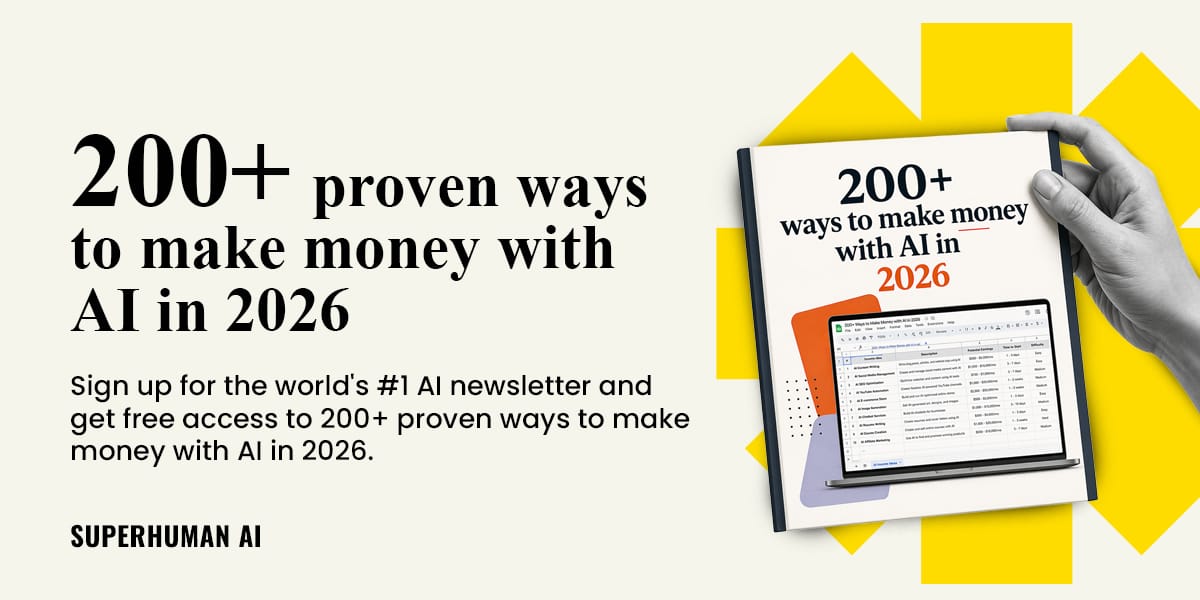
The next wave of millionaires will be people who figured out how to make AI work for them.
The window to get ahead is still open. But not for long.
Here are 200+ proven ways to make money with AI in 2026.
Sign up for Superhuman AI, the free daily newsletter read by 1M+ professionals, and get instant access to all 200+ ways to profit from AI this year.
Anthropic makes its most agentic Sonnet the default and gets Fable 5 back

Anthropic released Claude Sonnet 5 and made it the default model for every Free and Pro user, pricing it at an introductory 2 dollars and 10 dollars per million tokens through 31 August before it settles at 3 and 15. Sonnet 5 lands close to the flagship Opus 4.8 on agentic coding while costing far less, which pulls near-frontier autonomous coding into daily-driver territory.
The same day, after the US lifted its export-control directive, Anthropic redeployed Fable 5 globally with additional cybersecurity safeguards and published a draft jailbreak severity framework plus a HackerOne program for cyber researchers. Taken together, the two moves show the industry converging on shared security governance even as individual models get cheaper and more capable. Source link: Claude
10 Cinematic Prompts Techniques For Video
10 Practical Tips for Character Consistency
Google's answer to expensive video: a four-second image model and a talk-to-edit engine

Google shipped two generative-media models on 1 July. Nano Banana 2 Lite returns an image in roughly four seconds at about 0.034 dollars per 1K image, and Gemini Omni Flash, in public preview, generates and conversationally edits video at 0.10 dollars per second, matching Veo 3.1 Fast. Both are available through Google AI Studio, the Gemini API, and the Gemini Enterprise Agent Platform, and chaining them produces a cheap image-to-video pipeline for product and ad creative.

Every output carries an invisible SynthID watermark. The pricing is the story: Google is trying to make capable video generation cheap enough that cost stops being the constraint on volume creative. Source link: Google
12 Camera Moves Every AI Film-maker Should Know
10 Cinematic Prompt Techniques For Video
Midjourney + GPT IMG 2.0 + Seedance 2.0
Bullet Tracking Shot (+ prompt)
Prompts
Use the uploaded storyboard as the master reference for shot order, framing, timing, camera choreography, and transitions. Use the uploaded photorealistic bullet image as the visual reference for the gun, bullet, lighting, materials, and atmosphere.
Create a 12-second ultra-photorealistic Hollywood action sequence with seamless blockbuster cinematography and physically accurate ballistics.
The pistol remains completely still for the first 2 seconds while the camera performs a slow cinematic push-in. Thin smoke drifts naturally as the trigger is gradually squeezed and the firearm's internal mechanics move realistically. At 2.3 seconds, the firing pin ignites the cartridge, producing an intense muzzle flash, expanding gases, sparks, smoke, and realistic casing ejection.
At 2.5 seconds, the bullet exits the barrel and the camera transitions invisibly to a virtual high-speed camera rigidly mounted 20 cm behind the bullet and slightly below its centerline. The camera perfectly matches the bullet's speed, maintaining a fixed distance, angle, focal length, and centered framing throughout the flight.
The bullet remains razor sharp with realistic rifling spin, copper reflections, heat shimmer, shockwave distortion, and Mach cone effects while the industrial environment rushes backward with extreme directional motion blur, dust, sparks, debris, and volumetric lighting. Everything moves except the bullet.
As the bullet approaches the target, tension increases with stronger shockwaves, brighter reflections, and denser particles. At 11.6 seconds, the bullet impacts the target, creating a physically accurate explosion of debris, dust, fragments, sparks, and pressure waves. The camera remains attached until impact, then lingers briefly on the expanding debris before fading to black at 12 seconds.
Constraints: Follow the storyboard exactly. One continuous sequence. No extra shots. No orbiting, panning, tilting, rolling, zooming, reframing, handheld movement, camera shake, stabilization drift, or lens changes. Maintain premium Hollywood lighting, ARRI Alexa 65 color science, Phantom Flex 4K high-speed look, HDR, cinematic contrast, realistic combustion, authentic ballistics, premium particle simulation, and seamless visual continuity from the first frame to the final impact."
AI & Tech News
Meta decides its spare GPUs are a business
Bloomberg reported that Meta is building a cloud business, known internally as Meta Compute, to sell excess AI computing capacity and hosted models to outside customers, putting it into direct competition with AWS, Microsoft Azure, Google Cloud, and neocloud providers.
Meta shares rose 8.8 percent on the news, while CoreWeave plunged 13.9 percent to close at 85.68 dollars and Nebius Group sank about 17 percent to 229.18 dollars. The effort is overseen by senior executives including infrastructure chief Santosh Janardhan and Meta Superintelligence Labs' Daniel Gross.
The move could recoup some of Meta's heavy AI capex, but it also forces investors to accept margins well below its advertising business, and it reads as a signal that raw compute is behaving more like a commodity. Source link: Bloomberg
A neural net reads an ECG and finds a death risk signal cardiologists had missed
A team led by Ziad Obermeyer of UC Berkeley and Sendhil Mullainathan of MIT trained a deep learning model on 441,614 Swedish ECGs linked to death records and identified a high risk group for sudden cardiac death that standard tools overlook. The model reached an AUC of 0.872, against 0.697 for the standard AHA and ACC risk score, and flagged a group representing 2.2 percent of patients with a 7.0 percent annual rate of sudden cardiac death, most of whom current ejection fraction screening misses.
By pairing the classifier with a generative model that morphs low risk traces into high risk ones, the researchers surfaced a previously undescribed, human readable feature, a slurred terminal R wave in lead aVL. The result is notable because the system produced a new, mechanistically interpretable hypothesis rather than an opaque score, and it validated externally in US and Taiwanese cohorts. Source link: Nature
OpenAI's own usage data shows agents absorbing white collar work
OpenAI published usage data on Codex showing how far agentic work has moved beyond coding. By May 2026, 80.6 percent of sampled individual users had made at least one request estimated to exceed 30 minutes of human work, and 25.6 percent had made one estimated to exceed eight hours.
Non developers now make up about 20 percent of Codex's more than 5 million weekly users and are growing roughly three times faster than developers, and inside OpenAI, Codex accounts for 99.8 percent of weekly output tokens, with legal, finance, and recruiting crossing to majority use around April. The figures are self reported and OpenAI specific, but they are among the most concrete evidence yet that agentic tools are taking on longer horizon knowledge work, which matters for anyone planning headcount and tooling. Source link: Openai
NotebookLM becomes a heavier-duty research tool
Google says NotebookLM now includes advanced reasoning, code execution, and the ability to generate charts, spreadsheets, and slide decks. That turns it from a note organizer into a more capable research and presentation assistant.
For teams and students, the practical impact is faster synthesis of sources into something usable. It is also notable that Google is positioning the tool for broader work and education use. Source: Google Blog
Android 17 adds more AI into daily use
Google’s June update bundle includes Android 17 features such as floating app windows, Screen Reactions, and stronger device security tools. The important part is not just the interface changes, but the deeper integration of AI into mobile tasks.
Google is clearly aiming to make phones feel more adaptive rather than just more powerful. That shift usually matters most when it reaches mainstream users, not just developers. Source: Google Blog
Top AI tools to check out…
I’ve been building a best AI tool directory where you’ll find the best of the best tool and their USECASES.

How Satisfied Are You with Today’s Newsletter? |
Thanks for your time!
Shailesh & OpenAILearning team